Permits on Record, From Two Databases
The inspection tells you what the home looks like today. The property history report shows what the permit databases have on record as permitted, inspected, and signed off over the years. I run the address through BuildFax and BuildChek both, because no single database is complete, and a second search can turn up records the first misses. One $25 fee covers both.
The Inspection Can't Tell You What Was Permitted.
I look at what I can see, test, and operate. That's the job. Permit records are a different thing entirely. They sit in city, county, and state databases that aren't part of a home inspection, and I can't pull them while I'm standing in your crawlspace.
So I pull them separately. Did anyone permit that finished basement? Was the panel replacement inspected and finaled? Is there an open permit sitting on the property that turns into a problem when you refinance? Those answers are often on paper somewhere. The property history report goes looking for them.
You get two PDFs, one from BuildFax and one from BuildChek, delivered with your inspection report. Sellers often don't know about unpermitted work either, especially on a house that has changed hands four or five times.
Add it at booking. $25 covers both reports.
$25
One fee, two databases. No separate appointment and no second company to schedule. It goes on your inspection total and arrives with your report.
Two
Two independent permit databases, searched on the same address. Coverage is uneven from one jurisdiction to the next, so a second pull can catch records the first one misses.
Unpermitted work isn't always shady. Plenty of the time the previous owner just skipped the paperwork. It still matters for your insurance, your financing, and the day you go to sell. Better to know now.
Pairs well with a buyer's home inspection on any property with visible renovation history.
One Database Is One Set of Blind Spots.
Permit aggregators don't go dig through filing cabinets. They hold what each city, county, and state agency has digitized and sent along. Some jurisdictions report everything going back decades. Some started in 2011 and never went back. Some report building permits but not electrical.
That means a permit can show up in one database and be missing from the other, on the same address, on the same day. Running both takes me an extra minute and costs you nothing more.
Look at the sample report below. It's a Battle Ground property, and the permit history came from two different jurisdictions: Clark County for the mechanical work, and Washington's Department of Labor and Industries for five separate electrical permits. Search the county alone and you never see the electrical.
BuildFax
Groups the permit history by system, so roof, mechanical, plumbing, and structural work each get their own timeline. Flags the contractor on record and the declared value of the job.
BuildChek
A second pull across city and county permit databases nationwide. Different sourcing, different gaps, same address.
What's Actually in the Reports
Formatted PDFs, not raw government printouts. Here's what shows up.
Permit History by Address
Every permit the databases hold for the property, in order, with the type of work, the date it was pulled, and the jurisdiction that issued it. Electrical, plumbing, mechanical, roofing, structural, demolition, pool.
Open and Expired Permits
A permit that was pulled but never finaled shows as open. Somebody started the work under a permit and never got the final inspection. Open permits cause real headaches with title, with lenders, and with your own sale down the road.
Who Did the Work, and What It Cost
The contractor listed on each permit, plus the declared value of the job. A $16,000 heat pump permit tells you something a walkthrough won't. So does a licensed contractor's name next to work the seller described as a weekend project.
Multiple Jurisdictions in One Search
City, county, and state agencies all issue permits, and they don't share a portal. The reports pull from the sources each service covers in one search, so you're not logging into Portland's system, then Multnomah County's, then Washington's L&I.
Added at Booking, Delivered with Your Report
Nothing to schedule separately. Add it when you book and both reports show up with your inspection findings.
Add It When You Book
Select it online or mention it when you call. The $25 goes on your inspection total. That's the whole process on your end.
Both Databases Get Searched
I submit the property address to BuildFax and to BuildChek. Each one searches the city, county, and state permit records it has for that address and builds a report.
You Get Both PDFs
The two permit reports come with your home inspection report. You get them as they came from each service, not a summary of a summary.
Read Them Next to the Inspection
If the permit history and what I found in the house don't line up, I'll walk you through what the records show and what it means technically. Where the paperwork goes from there is a conversation for you and your agent.
When Does Permit History Matter Most?
It's worth checking on any home. These four situations are where it earns the $25 fastest.
Finished Basements and Additions
This is where unpermitted work turns up most often. If the home has a finished basement or a room addition, the permit history shows whether a permit is on record and whether a final inspection was recorded.
Garage Conversions and ADUs
Garage conversions and accessory dwelling units get built without permits all the time. Portland's ADU rules have shifted repeatedly over the years, so the permit record can tell you which version of the rules a project was built under, if any.
Older Portland Homes
A house built in 1952 has probably had four or five owners. Most of them did something. Not all of them pulled a permit. On a 1940s or 1960s home the permit history often says more than the seller disclosure does. Here's what buying an older Portland home typically turns up on inspection.
Homes with Visible Renovation
New kitchen. Updated baths. Replaced panel. Fresh roof. If you can see the work was done, the permit history shows whether there's a permit on record for it. That matters more than most buyers expect when it's their turn to sell.
Here's What a Report Looks Like
This is the BuildFax half of the package, run on a Battle Ground property. Permits are grouped by system and listed individually, each with the jurisdiction, the date, the status, the declared value, and the contractor on record.
If nothing is open and nothing looks out of place, that shows up clearly too. A clean report is still a useful report. It means nothing open or out of place turned up in the databases searched.
You get it alongside your home inspection report, along with the second pull from BuildChek.
View the sample permit report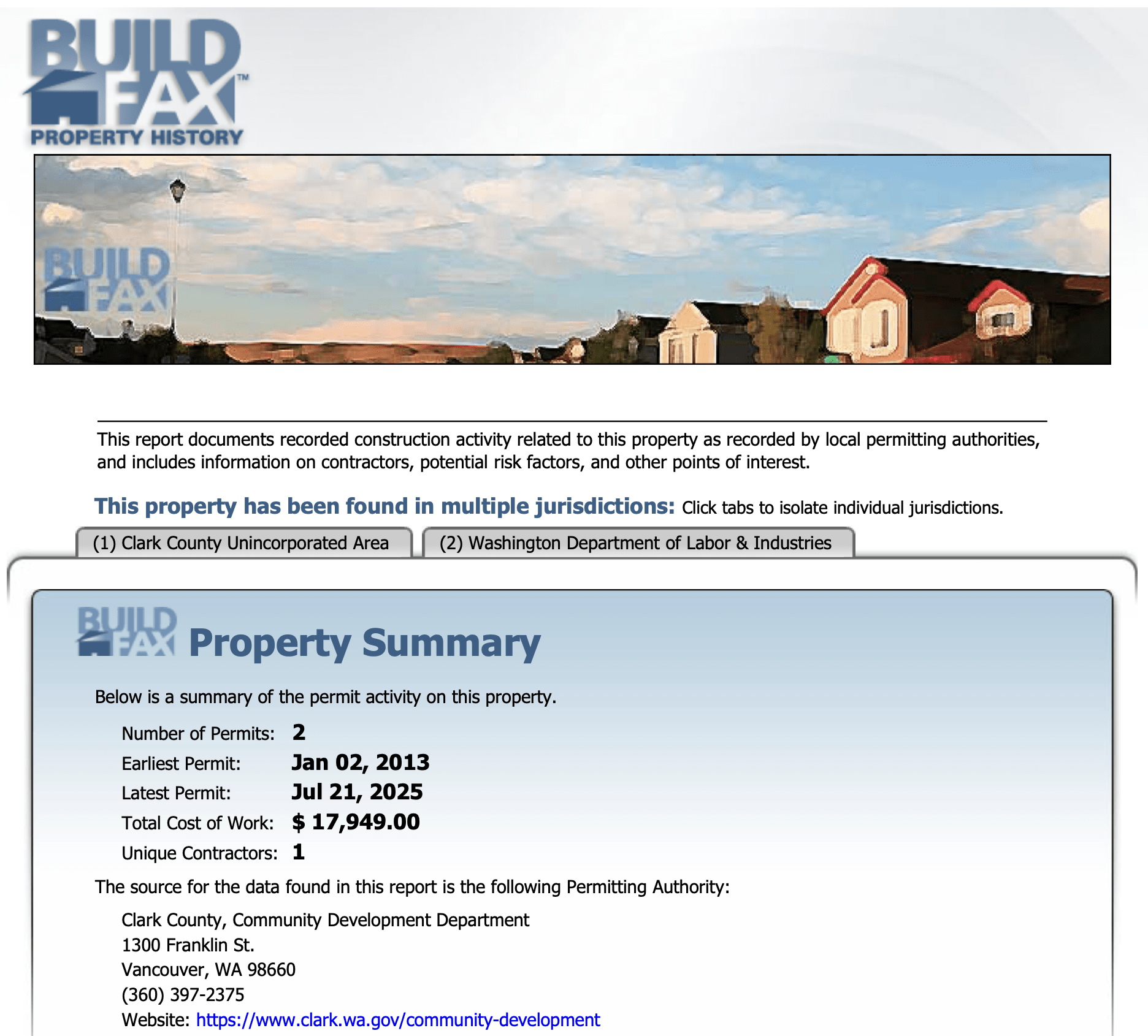
Property History Report FAQ
Two Permit Reports. $25 at Booking.
Add it when you schedule. Both PDFs come with your inspection report. No separate appointment, no second company to chase.
Questions? Call, text, or email office@trustedhome.org