Russ did a wonderful job inspecting our house. He was very flexible with his scheduling and made time for us on a Sunday morning. His inspection was very thorough and detailed. I appreciated that he took extra time to walk us through everything and answer any questions that we had. He made several great suggestions to us for repairs/improvements. I have been through a couple of different inspections over the years and Russ' was the absolute best. I highly recommend him if you are a buyer and looking for a very detailed home inspector.
Bethany Home Inspection by an Inspector Who Knows What Builders Miss.
Bethany is one of the Portland metro's fastest-growing neighborhoods, with new construction in Summercrest, Bethany Village, and the Rock Creek corridor going up every year. New doesn't mean defect-free. As a Certified Master Inspector® with 10+ years of inspection experience and hands-on work as a licensed general contractor, Russ knows what builders leave behind.

Bethany (Washington County) Housing Market
Showing Washington County, OR data
(Redfin does not publish city-level stats for this area).
$575,712
Median sale price
37 days
Median days on market
522
Homes sold per month
1,928
Homes for sale now
Bethany Know-How
These Homes Have History. So Do I.

Bethany, Oregon
Bethany isn't one neighborhood. It's Cedar Mill ranches from the 1960s sitting two blocks from Summercrest homes that were framed last year. Bethany Village has 1990s subdivisions with aging CPVC plumbing and 25-year roofs nearing the end of their rated life. Juel Park and Bonny Slope have mature lots, 1980s electrical systems, and crawlspaces that have been managing Washington County's clay soil and wet winters for decades. And then there's the new construction wave, fast builds with tight timelines and the kind of installation shortcuts I find every single week.
I have 10 years of inspector experience, and I am also a licensed general contractor. Difficult, high-end framing is my specialty, though I've also replaced roofs, built and installed cabinets, run wiring, poured concrete, waterproofed showers, set tile, and put in siding and windows, installed drywall, and set doors. That background lets me read a home the way the builder did, and catch what they got wrong.
When I walk a new build in Summercrest or the Rock Creek corridor, I'm not checking boxes. I'm looking at whether the bathroom exhaust fan actually terminates outside, whether the attic insulation baffles are in place, whether the grading sends water away from the foundation or toward it. Those are the things that don't show up until after you close, unless someone documented them first.
I hold Certified Master Inspector® certification, Oregon OCHI license #1898, and Washington DOL license #1856. Every inspection includes free thermal imaging.
Before You Buy
Bethany Homes by Construction Era
Bethany's housing stock spans more than six decades. The era your home was built in tells you a lot about what the inspection will find and what to watch for before you close.
Pre-1965 Homes
The Cedar Mill area carries the oldest housing stock in what is now the broader Bethany community. These are ranch-style homes on larger lots, built before the suburban growth wave hit Washington County. If you are buying one of these, you are looking at a home that is 60-plus years old and has almost certainly been updated piecemeal by multiple owners.
Galvanized supply pipe rusts shut from the inside. After 60 years, the internal diameter shrinks, water pressure drops, and discoloration shows up at fixtures. A full repipe typically runs $10,000 to $25,000 depending on home size. The cast iron waste line went in the same year and has aged the same way. Root intrusion, scale buildup, and joint seepage are consistent findings. A sewer scope is essential on any pre-1965 home.
Electrical systems reflect decades of patchwork updates. The panel may have been replaced once or twice, but the wiring behind the walls doesn't always match. An older house takes me longer simply because there is more to write down.
Common findings in pre-1965 homes
Galvanized steel supply pipes
Corroded internally. Restricted flow and discoloration common. Replacement typically $10,000 to $25,000.
Cast iron drain lines
60-plus years underground. Scale narrowing the pipe, seepage at the joints, roots working in. Sewer scope essential.
Crawlspace moisture and wood rot
Foundations poured before modern waterproofing hold moisture against themselves year after year. Clay soil makes it worse.
Patchwork electrical updates
Owner work layered over several decades, not all of it permitted. Mixed wiring types common.
Roofs near or past typical service life
Usually on a second or third covering by now. Approximate covering age, layer count and condition all go in the report.
1965 - 1985 Homes
This is when Cedar Mill and the Juel Park and Bonny Slope areas started filling in with suburban tract housing. These homes are now 40 to 60 years old and have entered the phase where deferred maintenance and aging systems become the story. They look fine from the street. Inside, there is usually a list.
Federal Pacific and Zinsco electrical panels are still present in some homes from this era. The failure record on both is well documented, and Washington County carriers act on it. Polybutylene plumbing was installed across Oregon from the late 1970s through the mid-1990s. It degrades with chlorine exposure and fails at fittings without warning. Replacement typically runs $10,000 to $20,000. I check for it on every inspection.
Crawlspace moisture is a consistent issue in Bethany's clay-heavy soil. Older vapor barriers and foundation drainage weren't designed for Washington County's wet winters. I physically enter every accessible crawlspace.
Common findings in 1965 - 1985 homes
Polybutylene plumbing
Common in Oregon homes built or remodeled between 1975 and 1995. Fails at fittings. Replacement typically $10,000 to $20,000.
Federal Pacific and Zinsco panels
Documented safety concerns. Insurance carriers frequently flag or decline coverage on homes with these panels.
Crawlspace moisture
Clay soil and older vapor barriers are a poor combination. Moisture, wood deterioration, and failed drainage are common in this era.
Composite wood siding
1970s and 1980s hardboard siding absorbs moisture in wet climates. Fails from the bottom up. Common in this era across Washington County.
Roofing and sealant age
A house past 40 is usually on its second roof. I record approximate covering age and condition.
1985 - 2005 Homes
Bethany Village, much of the Rock Creek area, and the established subdivisions along NW 185th Ave grew during this period. These houses are 20 to 40 years old now, which is when deferred work starts arriving all at once. They look solid. The systems that were installed new in 1995 are aging on schedule, and the maintenance clock has been running for a while.
An early-2000s roof is at the back end of its 25-year rating. Window and door sealants have gone hard and split open. CPVC plumbing, used widely in Oregon new construction from about 1995 to 2005, becomes brittle with age, especially near heat sources. Fittings crack first on CPVC, so that is where the flashlight goes, along with any run left unsupported. And in Washington County, radon is a factor regardless of home age.
Homes in this era also commonly have deck ledger connection deficiencies. Early-2000s code requirements around hold-down hardware and ledger bolting weren't as strict as current standards. I document these on every inspection where an attached deck is present.
Common findings in 1985 - 2005 homes
CPVC plumbing brittleness
Becomes brittle with age and heat exposure. Cracking at fittings is the early warning sign.
Composite wood siding failure
1990s hardboard and wood-fiber siding absorbs moisture in wet climates. Fails from the bottom up.
Roofs at or beyond service life
25-year shingles from 1998 to 2003 are near or past typical service life. Replacement typically $10,000 to $20,000.
Radon in every era
The same soil sits under Bethany's newest streets and its oldest alike. Test every purchase.
Deck ledger connection deficiencies
Attached decks from these years fail at the ledger more than anywhere else.
Summercrest and New Construction
Summercrest and the newer pockets along the Rock Creek corridor represent Bethany's current growth edge. In a neighborhood built this recently, plenty of buyers skip the inspection because nobody has lived in the house. That assumption is expensive when it's wrong. Municipal code inspectors check minimum compliance at specific construction phases. They are not there for your walkthrough, and they are not working for you.
New construction in Bethany consistently turns up the same short list of builder mistakes: grading that directs water toward the foundation on freshly disturbed lots, bathroom exhaust fans that vent into attic space instead of outside, missing attic insulation baffles, HVAC ductwork that is improperly sealed or sized, and flashing errors at windows and rooflines. These are usually the builder's responsibility before you close, and a written report documents them.
The 11-month warranty inspection is designed specifically for buyers who want to catch defects before the builder's one-year warranty runs out. The clock starts at closing. Schedule before 10 months.
Common findings in new construction
Grading and drainage toward foundation
Freshly disturbed lots often drain toward the house instead of away. Common in new Bethany subdivisions and expensive post-close.
Bathroom exhaust fans venting into attic
Creates moisture conditions and potential mold. Usually the builder's responsibility before you close.
Missing attic insulation baffles
Blocks ventilation and reduces energy efficiency. Invisible without attic entry. Thermal imaging helps locate gaps.
HVAC installation defects
Improperly sealed ducts, disconnected exhaust vents, and improperly sized returns found regularly in Bethany new builds.
Flashing deficiencies at windows and doors
Improper installation allows moisture into wall assemblies that look completely fine from the outside.
Home Risk Quiz
Is Your Dream Home Hiding Significant Issues?
See Your Potential Home Through an Inspector's Eyes.
Transform your observations into a clear risk profile. In just two minutes, you will receive a breakdown of what a professional inspector would be concerned about based on what you saw.
2 minutes
Based on what you saw at the showing
No technical knowledge needed
Free Assessment
Begin
Assessment
8 quick questions. No contact info required.
1 of 8
01
How old is the home?
You'll have the year built from the listing or the seller. Home age is the single biggest driver of inspection risk.
02
What did the roof look like from the street?
Look for curling shingles, dark patches, missing granules, or visible moss. A good look at the roof from the ground can tell you more than you'd think.
03
Did you notice any musty smell inside the home?
A musty or earthy odor is the most reliable clue buyers can detect about crawlspace moisture or mold, even without going under the house.
04
Did you see the electrical panel? What did it look like?
It's usually in a utility room, garage, or hallway. Federal Pacific (orange breakers) and Zinsco panels are known fire risks and still common in Portland-area homes from the 1960s to 1980s.
05
Did you notice any water stains on ceilings or walls?
Look near the corners of ceilings, under windows, and in bathrooms. Even old-looking stains matter, they show water has been in places it shouldn't be.
06
How did the overall condition of the home feel?
Trust your gut. A home that feels well-loved and maintained usually is. One that feels neglected almost always has deferred items hiding out of sight.
07
Did the home have a finished basement, addition, or garage conversion?
These are some of the most common places to find unpermitted work. A finished space isn't automatically a problem, but without permits, there's no record of whether it was done safely.
08
Where are you in your homeownership journey?
This helps us tailor your results to your situation.
Know Your Neighborhood
Bethany Area by Area
Summercrest, the Village and the older slopes were built decades apart, and it shows in the reports. Here is what buyers typically encounter in each area.
Summercrest
2010s - present
Bethany's active new construction zone. High buyer demand and fast builder timelines are a combination that produces installation shortcuts. Grading, HVAC, flashing, and attic insulation are the most common problem areas. The 11-month warranty inspection is especially valuable for buyers who closed here in the last two years.
Bethany Village
Late 1990s - 2000s
The heart of the neighborhood. A mix of late-1990s and 2000s construction with newer infill. Roofs are approaching end of service life. CPVC plumbing in older homes warrants attention. Early-2000s HVAC systems are aging. These homes look great and need a real inspection before closing.
Juel Park & Bonny Slope
1980s - 1990s
Established neighborhoods with mature landscaping and larger lots. Homes from this era can carry polybutylene plumbing, aging electrical panels, and crawlspace moisture issues tied to Washington County's clay-heavy soil. Roof condition and sealant age are primary focus areas on these properties.
Cedar Mill Area
1960s - 1980s
The oldest housing in the Bethany area. Ranch-style homes on larger lots with decades of deferred maintenance and patchwork updates. Galvanized plumbing is still present in some homes. Electrical systems from this era require close attention. Great neighborhood, but inspection is not optional here.
Rock Creek Corridor
Mixed eras
A wide mix of housing ages along NW 185th and the Rock Creek area. Some older homes sit next to newer infill construction. Each property needs to be evaluated on its own era and condition. Crawlspace moisture and radon are consistent concerns throughout this corridor.
NW Portland Border Area
Mixed eras
Properties along the Portland city line where Bethany blurs into NW Portland. Some HOA-governed communities, some not. Housing ages vary widely. What the inspection covers is the physical condition of the house. HOA documents, drainage, and utility connections are separate due diligence items buyers should review before closing.
Washington County Risk Factors
What Makes Bethany Homes Different to Inspect
Washington County's clay soils, EPA radon designation, and rapid new construction pace create inspection concerns that are specific to this part of the Portland metro.
EPA Radon Zone 2
EPA rates Washington County as Zone 2, moderate radon potential, and individual homes still test above the action level. The gas rises out of the soil and finds its way in through foundation cracks and crawlspace openings. It's the second-leading cause of lung cancer in the U.S. Many Bethany buyers assume homes with crawlspaces or mitigation systems don't need testing. They do. Radon levels shift based on soil conditions, foundation type, and ventilation. The only way to know your home's level is to test it directly.
EPA Zone 2, moderate potential
Clay Soil and Crawlspace Moisture
Washington County's clay-heavy soil holds water and doesn't drain well. That's a problem for crawlspace foundations. Water pools at the perimeter, vapor moves through, and wood in the crawlspace takes the hit. Older homes from the Cedar Mill and Juel Park areas have had 40-plus years of this to deal with. Even newer homes can have drainage issues when grading wasn't established correctly. Crawlspace entry and moisture readings are part of every inspection.
Consistent finding across all Bethany eras
New Construction Defects
Bethany's rapid building pace has produced a predictable list of defects. Tight timelines mean subcontractors cut corners that pass code inspection but fail performance. Grading, attic ventilation, exhaust fan termination, HVAC sealing, and window flashing are the most common problem areas I find in new Bethany builds. These are usually the builder's responsibility before you close, and a written report documents them.
Found on new builds every week
Real Inspection Photos
What Inspections Turn Up in Bethany-Area Homes
Real photos from Russ's Beaverton and Hillsboro inspection reports, showing issues common in Bethany homes, new and old. Every report includes photos like these.
-

Bath fan air dumped at a gable vent can drift back into the attic and add moisture. Each fan should vent to its own exterior cap. Attic moisture and condensation problems -

The infrared camera flagged this cold ceiling area. In the attic above, insulation was missing and displaced. What thermal imaging finds that you can't see -

This crushed duct left one room with no airflow at its register. Ductwork defects are among the common findings in Bethany homes. -
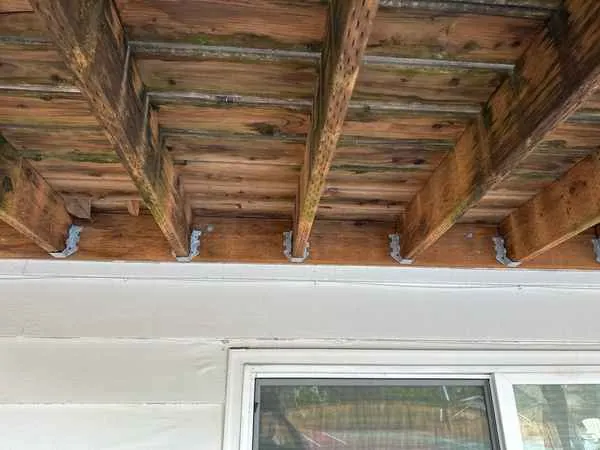
A ledger set straight against siding with no flashing can trap water behind it and rot the framing over time. Why deck ledger attachment matters -
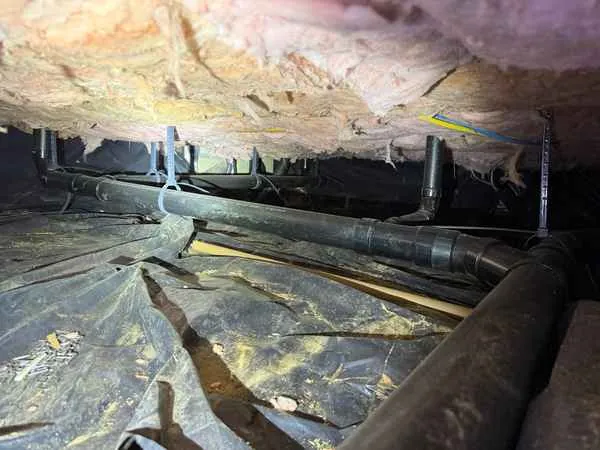
Builders often leave scrap behind in new crawlspaces. Wood debris can attract insects and hold moisture, so it should be removed. What builders miss on new homes -
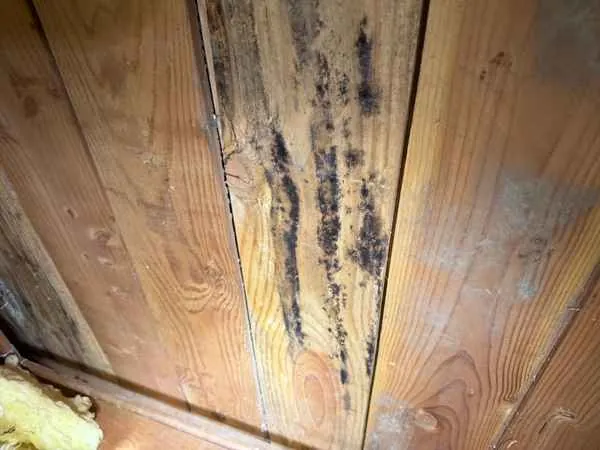
Apparent mold on a crawlspace subfloor points to high moisture below the house, a common issue with clay soils like Bethany's. What crawl space mold means
Inspection Scope
What We Check in a Bethany Home
Every inspection covers the major accessible systems and components, roof to crawlspace. We physically enter attics and crawlspaces. We operate every system we can safely access. We do not check boxes. We evaluate the home.
Roof & Attic
Shingles, flashing, gutters, attic insulation, ventilation, and moisture.
Electrical
Panel, breakers, wiring type, outlets, GFCI and AFCI protection.
Plumbing
Supply pipe material, drain lines, water heater, pressure, and fixtures.
HVAC
Furnace, AC, heat pump, ductwork, and distribution. Age and condition noted.
Foundation & Structure
Cracks, settling, retaining walls, and visible structural framing.
Crawlspace
Full physical entry. Moisture, vapor barrier, insulation, and wood rot.
Interior
Walls, ceilings, floors, windows, doors, and built-in appliances.
Exterior & Grading
Siding, deck, driveway, grading, and drainage away from foundation.
EPA Radon Zone 2
Radon Testing in Bethany
Washington County carries EPA Radon Zone 2 designation, moderate radon potential. Radon is a colorless, odorless radioactive gas produced naturally by uranium breaking down in soil and rock. It seeps into homes through foundation cracks, crawlspace openings, and soil contact. You cannot smell or see it. The only way to know your level is to test.
Many Bethany buyers assume that homes with crawlspaces are automatically at higher risk while slab-on-grade new construction is fine. That's not how radon works. Levels depend on soil conditions, foundation type, ventilation, and seasonal variation. A reading from the house across the street has no bearing on yours. Every purchase needs its own test.
We recommend radon testing on every Bethany inspection. If levels exceed 4 pCi/L (the EPA action level), a mitigation system typically costs $800 to $1,500. Simpler to sort out while the house is still under contract. It's much harder to resolve after.
Learn About Radon Testing →Radon facts for Bethany buyers
#2
Second-leading cause of lung cancer in the U.S.
After smoking. Responsible for about 21,000 deaths per year nationally.
48h
Test takes 48 hours
Continuous electronic monitor placed at the start of the inspection. Digital results delivered promptly.
$150
Added to your inspection
Standalone testing is $225. Add it at booking and save $75.
Transparent Pricing
Simple, Flat-Rate Pricing
No hidden fees, no surprise add-ons. Thermal imaging is included on every inspection.
Starter
Standalone Inspection
$395up to 1,000 sq ft
- Full home inspection
- Free thermal imaging
- Roof & crawlspace
- Detailed digital report
Most Common
Inspection + Radon
$545up to 1,000 sq ft
- Full home inspection
- Free thermal imaging
- Detailed digital report
- 48-hour radon test
Best Value
Inspection + Radon + Mold
$790up to 1,000 sq ft
- Full home inspection
- Free thermal imaging
- Detailed digital report
- 48-hour radon test
- Mold air sampling & lab results
Starter
Standalone Inspection
$295up to 1,000 sq ft
- Interior-only inspection
- Free thermal imaging
- Electrical, plumbing, HVAC
- Detailed digital report
Most Common
Inspection + Radon
$445up to 1,000 sq ft
- Interior-only inspection
- Free thermal imaging
- Detailed digital report
- 48-hour radon test
Best Value
Inspection + Radon + Mold
$690up to 1,000 sq ft
- Interior-only inspection
- Free thermal imaging
- Detailed digital report
- 48-hour radon test
- Mold air sampling & lab results
48-Hour Monitor Test
$150with home inspection
Clark County, WA sits in EPA Radon Zone 1, and elevated readings turn up across the Portland metro. Testing is the only way to know. Standalone test: $225
With home inspection$150
Standalone radon test$225
Test duration48 hours
Air & Surface Sampling
$245with home inspection
Portland’s wet climate makes mold a real concern. Air samples are analyzed by Sporecyte, an accredited laboratory, which identifies mold types and spore concentrations. Standalone mold inspection: $445
Standard package (2 air + 1 control)$245
Additional air samples$75 each
Surface swab$70 each
Lab analysis & reportIncluded
Pool & Spa Evaluation
$295with home inspection
Save $100 vs. standalone. In-ground spas included at no extra charge. Free-standing hot tubs are not inspected. Accessible components inspected, including shell, pump, filter, heater, and safety systems.
With home inspection$295
Standalone inspection$395
In-ground spa includedYes
Most reportsSame day
See our full pricing page for all size ranges.
Client Stories
What people say about Russ
Real reviews from clients across Portland Metro & SW Washington.
Russ was very detail-oriented and thoroughly inspected every inch of the house. His report made it easy to identify and address necessary repairs. We were very happy with his work, professionalism, and communication throughout the process. We would absolutely use him again for our one-year warranty inspection and any future inspections. Highly recommend!
We had two home inspections completed with Russ. The inspections were exceptionally thorough offering detailed insight into the homes. He did a great job with inspecting the entire roof and crawlspace. If I need another inspection, he would be my first call.
Russ did our 1 year warranty inspection and was absolutely amazing. Very thorough and found stuff that was never initially caught during our purchasing inspection. Thank you Russ!
I am a real estate agent in the Portland area that loves when my clients pick Russ. He has a non-alarmist way of describing his findings that helps each person to learn and understand in a better way. I appreciate his expertise and also, his sense of humor!
Great inspector! Honest and trust worthy
Highly recommend! Professional, thorough, and trustworthy are the words I would use to describe this business!!!
My wife and I had an excellent experience. They were professional, punctual, and extremely thorough. The report was detailed, well-organized, and delivered promptly, with clear photos. This inspection gave me complete confidence in my home purchase.
Very professional and honest inspector. Will not sugar coat the details. Very thorough and rigorous!
I can't recommend Russ enough, hands down, the most thorough, professional, and knowledgeable inspector out there!
Russ from Trusted Home Inspections is the best inspector ever. His report was so thorough and detailed that it made post inspection repairs and negotiations easy, reasonable and fair!!
Russ was a pleasure to work with. He communicated clearly, arrived on time, and conducted a thorough and detailed inspection. His professionalism gave me confidence in my home purchase decision.
Russ is fair, honest, and to the point. His extensive expertise is evident in his detailed reports. Nothing is missed!
Russ is a great inspector, honest, trustworthy, cares about his work being better than 'good enough,' and his expertise will be used in upcoming projects for family, friends, and coworkers!
We couldn't be happier! Russ was absolutely outstanding from start to finish, from the roof and attic to the foundation, electrical, plumbing, and everything in between. He did a radon test for us as well and the whole process was smooth.
Excellent home inspection service! Thorough, professional, and easy to understand. The inspector was patient, detailed, and provided a clear, well-organized report quickly. Highly recommend!
If you want an honest truth about any dwelling, call Russ. He will do his due diligence and put it in writing. 10/10 recommended
We had an excellent experience working with Russ. Professional, punctual, and extremely thorough. His report was detailed, easy to follow, and delivered promptly. We felt confident moving forward thanks to his expertise.
Russ is extremely knowledgeable and personable. I have used his services several times. In addition to his extensive experience, he also has a solid construction background, so he really knows what's what. Highly recommend!
If you're looking for an inspector who will do an honest, thorough inspection, choose Russ @ Trusted Home Inspection. I don't know of another person I could recommend over him. 10/10!
Russ is an outstanding inspector. Extremely thorough and very knowledgeable. He will crawl where others won't, and will see what others are blind to. Would 100% recommend his company to EVERYONE.
Russ was very detailed and found out way more details that were missed by other inspectors. He is very knowledgeable and detail oriented! Will definitely go with him next time I need an inspection.
Russ came recommended by our agent, and it's easy to see why. Compared to friends who recently bought homes and used other inspection companies, the level of detail here was unmatched. We have no complaints and would absolutely work with them again.
Russ was fantastic. Very thorough, personably, and prompt. He even got up on a pretty steep roof in the rain, which I didn't expect. Would highly recommend him for your home inspection.
Russ was incredibly thorough, very friendly, and answered all of our questions. We are first-time buyers, and we felt very well taken care of by Russ. His report was super informative and detailed, and gave us great next steps. Thanks Russ!
Russ was incredibly thorough and detailed, and his inspection really made me feel more comfortable with my home purchase. Thank you, Russ!
Russ is very thorough and finds every little detail. Very honest inspector and I can rest assured knowing my home was inspected by him.
We had an excellent experience with our home inspector. He was professional, thorough, and took the time to explain everything clearly. The inspection was very detailed, and the report was easy to understand with helpful photos and recommendations. He identified issues that could have easily been missed and gave us confidence in our home purchase. I highly recommend his services to anyone looking for a knowledgeable and trustworthy home inspector. Thank you for the outstanding work!
Russ did a fabulous job inspecting our home. Not only was he thorough and professional, but he offered supportive follow-up via an in-depth 2-year maintenance calendar. He is a very clear communicator, very honest. Since living in the house, our experience noticing small quirks or repair items in the home matches Russ's inspection notes perfectly. Don't hesitate to work with him!
Russ did an 11 month warranty inspection for me and was incredibly thorough. He found over 50 items that needed to be addressed before the builder's warranty expired. What I appreciated most is that he actually listened to the concerns I raised and took the time to look into them. The report he gave was detailed and easy to follow, which made it simple to pass along to the builder. If you're looking for a home inspector who's meticulous and genuinely looks out for his clients, I would highly recommend Trusted Home Inspections.
Russ was AMAZING! Super thorough, responsive and gave us so much detail. The seller had done a pre-inspection and Russ did one for us as the seller. No comparison. We felt so confident going into negotiations and understanding everything. Hire Russ. You won't regret it.
Russ was great to work with! Timely, efficient and very easy to ask questions along the way. At the end of this inspection he answered all our questions without making us feel rushed! He made the whole process super easy and straightforward. Thank you!
A thorough and professional inspection. Russ answered all of my questions and made me feel confident about decisions that were required.
Super thorough and kind. Feel good with their assessment and feedback.
Russ is thorough, kind, and wants what is best for his customers. Highly recommend!
Excellent work, I am very pleased!!!
Thorough inspection and timely report
Common Questions
Bethany Home Inspection FAQs
Questions buyers in Bethany and Washington County ask most before booking.
Bethany home inspections start at $395 for homes up to 1,000 sq ft and scale by square footage up to $845 for homes up to 5,000 sq ft. Most homes in the 97229 zip code fall in the $545 to $695 range. Free thermal imaging is included at every price point. See full pricing at trustedhome.org/pricing.
Yes. For a Bethany buyer, the new construction inspection may be the most useful thing on the list. The county checked set stages during the build against a minimum standard. They don't evaluate the finished home. In Bethany new builds I regularly find grading that directs water toward the foundation, HVAC defects, bathroom exhaust fans venting into attic space, flashing errors at windows and doors, and insulation gaps. These are usually the builder's responsibility before you close, and a written report documents them. We also offer an 11-month warranty inspection for buyers who want to catch issues before their builder warranty runs out.
Yes. Bethany falls in Washington County, which is EPA Radon Zone 2, moderate radon potential. Radon levels depend on the specific soil, foundation type, and ventilation of your home. Your neighbor's result tells you nothing about yours. Testing is the only thing that answers it. Radon testing is $150 when added to your inspection, or $225 as a standalone service.
An 11-month warranty inspection puts construction defects on paper while your builder's warranty still applies. Most builders in Bethany include a one-year workmanship warranty. After that, repairs may fall to you. Schedule around the 10-month mark to have time to submit claims before the deadline. Learn more about 11-month warranty inspections.
Most Bethany homes take 3 to 4 hours depending on size, age, and condition. Newer homes in Summercrest tend to run toward the middle of that range. Older Cedar Mill and Juel Park homes with more systems to document take longer. Sit in on the whole inspection or just join me for the walkthrough at the end.
Thermal imaging is included at no extra charge on every inspection. Russ includes it because the infrared camera often shows temperature differences that can point to insulation gaps, moisture intrusion, and HVAC leaks that are invisible to the naked eye. In Bethany new construction, it's one of the most valuable tools we use. Learn more about thermal imaging.
Certified Master Inspector® (CMI®) is a board-certified designation from the Master Inspector Certification Board. To qualify, an inspector needs at least three years in the inspection business, 1,000 or more fee-paid inspections and hours of training and education combined, completed professional education, agreement to the board's code of ethics, and consent to periodic criminal background checks. Russ is Oregon City's only Certified Master Inspector® with 10+ years of home inspection experience and 100+ inspectors trained, serving Bethany and Washington County. Learn more about the CMI® designation.
Your report is delivered through Spectora with high-resolution photos of every significant finding, severity ratings, and plain-language explanations. The priority is accuracy and detail. Most reports go out the same day. After you receive your report, call or text with any questions. Unlimited follow-up is included.
Yes. Trusted Home Inspections is veteran-owned and takes 10% off the inspection fee for veterans, active duty, reservists, National Guard members, and military families. Mention your service when you book. See full details at trustedhome.org/military-discount.
That decision is yours and your agent's to make, and the inspection contingency period is when you have it to make. After closing, you don't. The report is your documentation. Russ is available after delivery to help you understand what is critical, what is manageable, and what requires a specialist to evaluate further.
Where We Inspect
Serving Portland Metro & Southwest Washington
Available 7 days a week. No travel fee within 40 miles of Oregon City, and $50 past that. Not sure if we cover your area? Just call.

Oregon Certified
OCHI Lic. #1898

Washington Licensed
DOL Lic. #1856
Multnomah County home inspections. Portland and the rest of Multnomah County are full of older housing stock, including 1920s craftsman bungalows in SE Portland, Pearl District lofts, and mid-century homes in NE Portland. Older homes mean knob-and-tube wiring, cast iron drains, and aging foundations. I’ve inspected hundreds of homes across Multnomah County and know what to look for in each neighborhood.
Clackamas County home inspections. Clackamas County is home base for me. Oregon City, Lake Oswego, West Linn, and Happy Valley are where I do most of my work. EPA rates Clackamas County as Radon Zone 3, but individual homes still test high, so radon testing belongs on every Clackamas County home inspection. I know the local builders, the common defects, and the soil conditions that drive moisture problems in this part of the metro.
Washington County home inspections. Beaverton, Hillsboro, Tigard, and Tualatin are growing fast, with new construction next to homes from the 70s and 80s. Washington County home inspections often catch builder-grade shortcuts in newer subdivisions and aging mechanical systems in established neighborhoods. The wet Tualatin Valley climate also makes moisture intrusion and crawlspace issues more common than buyers expect.
Clark County home inspections in Southwest Washington. Vancouver, Camas, Washougal, and Battle Ground sit just across the Columbia River, and I’m licensed in Washington (DOL #1856) to inspect them. Clark County home inspections come with their own quirks: hillside foundations in Camas, manufactured homes in outlying areas, and the same wet Pacific Northwest climate that drives moisture and mold concerns. Same standards I apply on the Oregon side, no extra travel fee.
Don’t see your city? We likely cover it.
View All Service AreasReady to Schedule Your Bethany Inspection?
Available 7 days a week. Online booking open 24/7.